Whole School Approaches
What Does This Look Like at Lake Colac School?
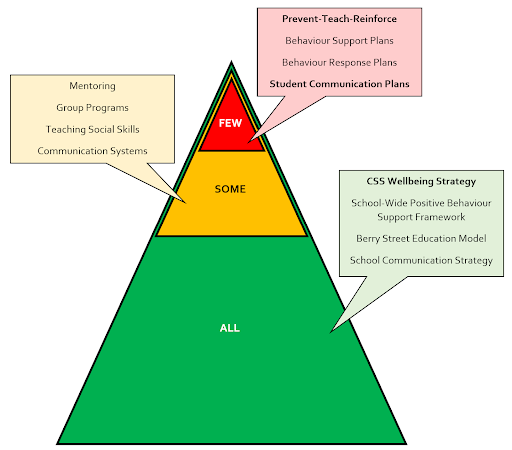
School-Wide Positive Behaviour Support caters for all students across the school. It is taught through our school values and behaviour expectations.
Prevent-Teach-Reinforce focuses on specific students who require extra individualised behaviour supports. This usually requires a team approach to design a Behaviour Support Plan with associated strategies.
The Berry Street Educational Model is taught in the classroom as part of the curriculum. It is taught through our social/emotional (SEL) learning sessions and includes the teaching of specific strategies.
Communication is an individualised system of supports to address the expressive and receptive communication needs of our students. This includes whole school strategies and individualised programs. This may include the use of Key Word Sign, AAC, ALDs and other supports that the student requires.
School Wide Positive Behaviour Support
School-Wide Positive Behaviour Support (SWPBS) is an evidence-based framework for responding to student behaviour. It aims to create a positive school climate, a culture of student self-regulation and an open, responsive management system for all school community members. It includes analysis of behavioural and responsive data and implementation of evidence based instructional and corrective practices. SWPBS also supports the development of organisational systems for establishing safe, purposeful and inclusive school and classroom learning environments, while providing individual behaviour and learning supports needed for all students to achieve academic and social success.
SWPBS identifies and teaches positive replacement skills and builds relationships. It relies primarily on positive approaches and has a goal of sustained results achieved over time. SWPBS is not limited to any particular group of students, it is for all students (Sugai, 2005).
Prevent - Teach - Reinforce
What is Prevent-Teach-Reinforce (PTR)?
Prevent-Teach-Reinforce (PTR) sits at the top of Lake Colac School’s Multi-Tiered System of Support (MTSS). PTR is a process to be followed in order to develop behaviour support strategies for students with challenging behaviours.
PTR is an evidence-based approach to supporting students who exhibit behaviours of concern that is based on a functional assessment process. It is used to develop individualised Behaviour Support Plans (BSPs) for students for whom other interventions have not worked. It is a collaborative model that uses key members of the school team to support its development.
In most cases, the schools School-Wide Positive Behaviour Support (SWPBS), Communication, and curriculum-based programs will be able to support the moderation and safety of students with complex behaviour needs. The PTR process is used where the strategies that apply to ALL or SOME of our students aren’t working for the FEW who require individualised targeted interventions.
Berry Street Education Model
The Berry Street Education Model (BSEM) supports teachers to meet the needs of some students, particularly those who have been affected by trauma.
Schools often require specialised strategies to address student needs for growth, and achievement.
Many students encounter daily challenges that can impact their success at school.
The BSEM is a practical approach to teaching and learning that enables teachers to increase engagement and successfully improve self-regulation, growth and educational achievement in students. The strategies incorporate positive education and wellbeing practices.
Communication
What is Communication?
Communication is the process of exchanging views, feelings, information, knowledge and experiences. It takes a wide variety of forms, from two people having a face-to-face conversation through modes which include speaking, writing and gestures to highly supported interactions which may include the use of individual devices or other forms of AAC (Alternative and Augmentative Communication).
Communication is complex and involves two distinct but equally important processes:
- Expressive communication: This involves the sending of a message using a range of different forms of communication, including speaking or non-speaking (i.e. gesture, facial expressions, tone of voice, etc.). Pictures can also be used to send a message.
- Receptive communication: This involves the receiving and interpreting of a message, often called language comprehension. It is the ability to understand the intent and meaning of someone’s effort to communicate.


